A customer limit order at the New York Stock Exchange once ended its journey as handwriting.
Before the 1970s, the Securities and Exchange Commission later reconstructed a familiar path. A brokerage branch received an order. The branch telephoned the firm’s order desk. The desk telephoned a booth on the exchange floor. A floor broker received a paper ticket and carried it to a specialist’s post. If the broker could not execute the order, the specialist could enter it by hand into the book. A trade report then moved back through much of the same chain. The 1968 paperwork crisis exposed the cost of that manual machinery and helped push exchanges toward automated routing, quotation, execution, and trade processing.1
Each role had an address. The order desk occupied a room. The floor broker crossed a floor. The specialist stood at a post. The book was an object. A telephone call had two ends.
Physical proximity still offered only a partial view. A customer away from the floor missed conversations around the post. The specialist kept the book inside the exchange rather than in a public database. Broker, dealer, and exchange relationships remained outside the visual record. In 1999, SEC proceedings concerning the NYSE described surveillance failures involving compensation arrangements among some independent floor brokers and the risks of trading ahead or front-running.2 Investigators had places to look, but no complete record of the market.
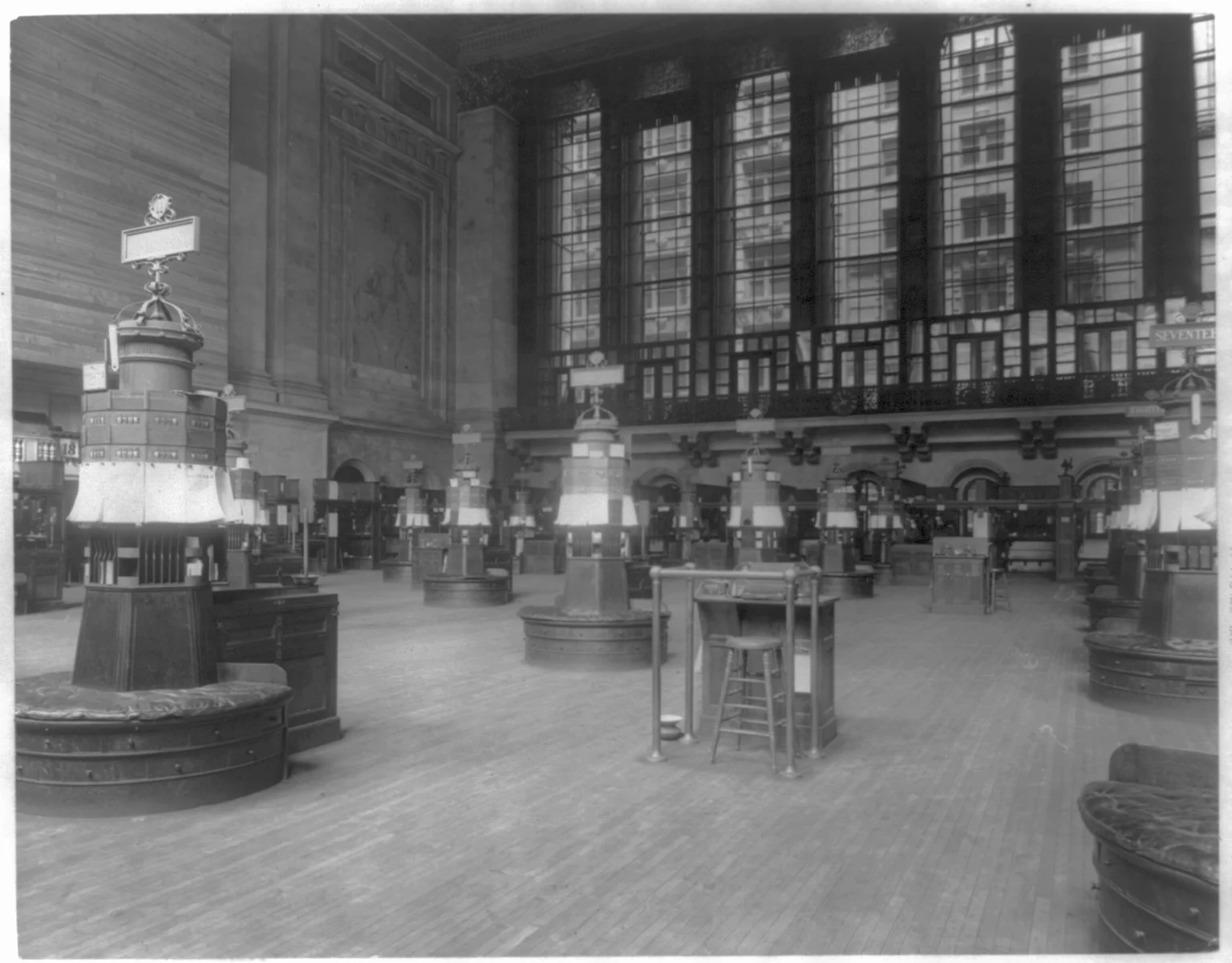
Automatic ticker apparatus, New York Stock Exchange, c. 1922
Library of Congress, Prints and Photographs Division. No known restrictions on publication. The floor already appears as a hybrid apparatus: people, quotation stations, telecommunications, and machinery in one room. Direct source.
A market with an address
Electronic-market histories often become substitution stories. First there were people, then machines. First judgment stood in a room, then code absorbed it.
That substitution story omits the choices that already shaped floor and dealer markets. On the floor, a broker could choose how to expose an order. A specialist maintained an order book and could also trade as principal. Dealer markets leaned on bilateral relationships, inventory, telephones, and reputation. Researchers could name the location of discretion more easily than they could measure its exercise.
Electronification entered this world in pieces. The SEC’s 1997 technology report described Nasdaq as a screen-based dealer market in which multiple market-maker interests appeared through electronic quotation. Yet outside systems such as SOES and SelectNet, many executions still relied on telephone communication. SOES gave qualifying small orders automatic execution against market-maker quotations. SelectNet let market makers transmit and negotiate orders through terminals. Instinet, which the SEC traced to 1969, supplied another electronic venue for professional trading. Island later appeared in the report as an automated limit-order book with automatic matching.1 The screen joined rather than displaced the telephone, dealer relationship, and limited-access network.
The layering became visible in the SEC’s mid-1990s Nasdaq investigation. The Commission found that market makers had followed a quoting convention across many firms that discouraged use of certain price increments, with consequences for quoted spreads. The Commission also found that Instinet and SelectNet could contain market-maker interest at prices superior to the public Nasdaq inside market. Access to those systems was narrower than access to the public quotation environment. The SEC described a two-tier structure: one public layer and another in which professionals could interact at better prices without changing the public inside quote.3
That period offers a poor place to search for a lost age of straightforward markets. A public screen could coexist with private conversations. A regulated quote could coexist with better-priced interest on a limited-access network. A visible market maker could participate through an anonymous electronic system. Human conventions could shape a computer-displayed price.
Access, rather than medium, separated these market layers.
Network documents, read cold
Early network culture understood part of this problem. In 1993, Eric Hughes linked privacy to tools and implementation in “A Cypherpunk’s Manifesto.” Timothy May had imagined cryptography changing the enforcement capacity of states and institutions. John Perry Barlow’s 1996 declaration went further and treated cyberspace as a domain outside the sovereignty of industrial governments.4
Those texts recognized that technical architecture can change what institutions can enforce. Their weaker move was the leap from capability to destiny. Networks still had operators. Access still had conditions. Software still had authors, owners, and administrators. Classification still determined which objects a rule applied to.
Market structure supplies a concrete correction. Networks relocate institutional choices into access conditions, operator rules, ownership, administration, and software configuration.
When a rule became part of the machinery
In 1996, after its Nasdaq investigation, the SEC adopted new order-execution obligations. One part concerned customer limit orders. Another addressed prices displayed in electronic communications networks. The regulatory problem was not whether computers should trade. The problem was whether superior buying or selling interest held inside an ECN should remain available only to participants with access to that network or become reflected in quotations available to the wider market.5
The response was infrastructural. The rules sought to expose certain customer limit orders through broader channels and to integrate qualifying ECN prices into the public quotation process. An ECN could provide access to its best prices while allowing the individual market maker behind an order to remain anonymous. A classification, a display obligation, and an access mechanism helped determine what the public market could see.5
Regulation and technology became interdependent. By 1998, when the SEC adopted Regulation ATS, alternative trading systems entered a more explicit framework for registration, access, display, and oversight.6
By then, asking who “made the market” identified an actor but missed the procedure. A researcher had to ask which participant originated the order, which broker received it, which route was selected, which venue admitted it, what that venue displayed, which orders its system could match, which participant supplied liquidity, and which rule determined whether information inside one network entered the consolidated public market. The procedure itself became the object of inspection.
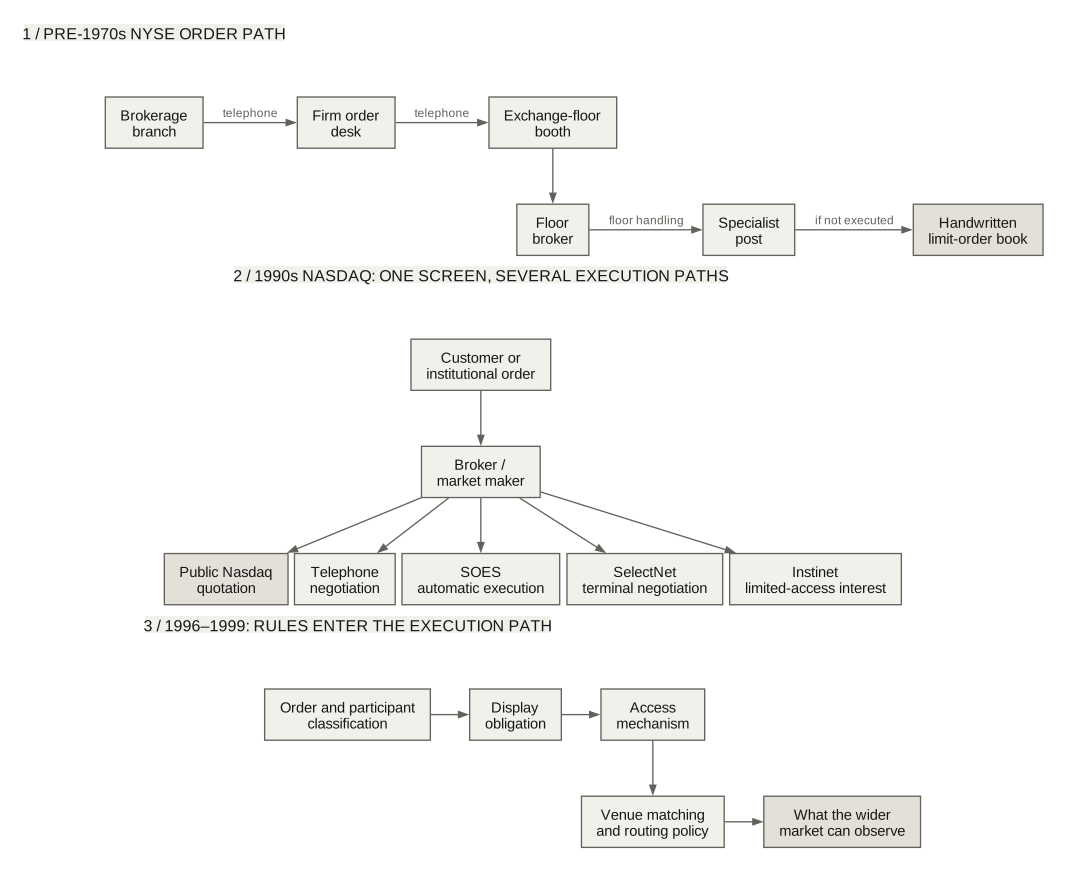
Three views of where discretion entered the order path
oldschools, reconstructed from the SEC records cited below. Original diagram. The diagram separates a physical order path, a hybrid screen-and-network market, and the regulatory classifications that altered what the wider market could observe. Method sources.
Scroll the diagram horizontally on small screens.
Langdon Winner argued in 1980 that technical arrangements could carry political properties. Susan Leigh Star asked researchers to study infrastructure through the practices and standards in which it becomes embedded. Geoffrey Bowker and Star treated classification as information infrastructure. Lawrence Lessig’s 1999 Code made a related claim about digital architecture: constraints can operate through the environment in which action becomes possible.7
The infrastructure literature provides one narrow method for financial markets: researchers cannot infer the location of a decision from the location of a decision-maker.
A specialist could be pointed to. A matching rule has to be reconstructed from documents, behavior, configuration, message formats, access rules, and event sequence. A broker’s routing policy leaves different evidence than a floor broker crossing a room. A classification that determines whether an order must be displayed can change the public market without resembling a trade.
Electronification improved measurability in some stages. Automated execution can produce records that a shouted negotiation lacked. Electronic books can impose procedures with more consistency than discretionary handling. At other stages, uncertainty moved into the sequence of institutional and technical decisions that shaped an order’s path.
After the floor
By the late 1990s, following an order no longer meant following one person through one room. A public quote could depend on display obligations, access rules, and prices held in systems that many participants could not enter. The physical path had become a procedural one.
Public blockchains changed the surviving record again. They add code and final state transitions to the evidence available to researchers, while much of a transaction’s earlier path may remain elsewhere. A trader can disclose an instruction to a wallet, a private forwarding service, or an auction before any transaction enters the public record. Different intermediaries can receive different information and exercise different choices over routing, matching, ordering, or inclusion.8
Settlement records the result of the path that succeeded. It does not record every participant that saw the instruction, every route that failed, every bid that lost, or every commercial agreement that shaped the result. Those facts survive, if they survive at all, in policies, interfaces, messages, and operator behavior.
The historical comparison rests on this sequence between an instruction and its execution. A researcher has to identify who first received the instruction, who could act on it, which rule selected the route, who carried the risk of execution, and how value changed hands.
MEV describes value available through control over transaction ordering and inclusion. It does not account for advantages created earlier in the path through selective disclosure, exclusive access, routing policy, or private payment. Those advantages require separate evidence and measures.8
The research position
The title survives only in a qualified form. There was no final moment when authority ceased to be visible. Older markets contained private knowledge, discretionary conduct, and incomplete supervision. Newer markets made some actions more standardized and auditable.
The historical record supports a narrower claim. Market participants and rulemakers distributed discretion across people, books, display rules, networks, classifications, routing choices, and matching systems. In contemporary execution, operators and intermediaries exercise related choices through auctions, interfaces, and software before a final transaction reaches a shared record.
oldschools reconstructs the path from the first disclosure of intent to final settlement. At each stage, we identify who can see the order, which rule or policy selects the route, who supplies liquidity, who carries execution risk, and who receives fees, spread, refunds, or informational advantage. We separate protocol rules from operator policy and private commercial arrangements.
Researchers can observe these choices through different records: transaction traces, formal rules, operating policies, interface documentation, messages, and market data. No record is sufficient alone. A useful finding connects them in the order a transaction encounters them and preserves the gaps that public evidence cannot resolve.
Research boundaries
This note reconstructs public execution paths and rule changes from regulatory records, official histories, infrastructure theory, and current protocol documentation. It does not recover proprietary routing logic, private order books, internal venue configuration, or the complete set of commercial relationships that surrounded any single trade. The diagram is a comparison device, not a claim that the three historical systems were equivalent.
The contemporary examples identify role definitions and execution interfaces from public documentation. They do not establish current market share, execution quality, private commercial terms, or whether each operator follows its published policy in practice. A rule filing or protocol specification can establish a formal obligation. It cannot establish how each participant behaved. An enforcement record can establish specific misconduct and supervisory failure; it cannot describe an entire exchange. Where the public record cannot distinguish formal design from actual practice, this note keeps the distinction open.
Source notes
Footnotes
-
U.S. Securities and Exchange Commission, “Report to the Congress: The Impact of Recent Technological Advances on the Securities Markets,” 1997. The report discusses pre-1970s NYSE order handling, the 1968 paperwork crisis, Nasdaq, SOES, SelectNet, Instinet, and Island. SEC report. ↩ ↩2
-
U.S. Securities and Exchange Commission, “In the Matter of New York Stock Exchange, Inc.,” Exchange Act Release No. 41574, June 30, 1999. SEC release. ↩
-
U.S. Securities and Exchange Commission, “Report Pursuant to Section 21(a) of the Securities Exchange Act of 1934 Regarding the NASD and the Nasdaq Market,” 1996, plus appendix. SEC report and appendix. ↩
-
Eric Hughes, “A Cypherpunk’s Manifesto,” 1993, Activism.net archive; Timothy C. May, “The Crypto Anarchist Manifesto,” 1988, MIT CSAIL archive; John Perry Barlow, “A Declaration of the Independence of Cyberspace,” 1996, Electronic Frontier Foundation. These texts are used as period evidence, not as a voice model. ↩
-
U.S. Securities and Exchange Commission, “Order Execution Obligations,” Exchange Act Release No. 34-37619A, 1996. SEC record. Federal Register record. ↩ ↩2
-
U.S. Securities and Exchange Commission, “Regulation of Exchanges and Alternative Trading Systems,” Exchange Act Release No. 34-40760, 1998. SEC release. ↩
-
Langdon Winner, “Do Artifacts Have Politics?,” Daedalus, 1980, JSTOR record; Susan Leigh Star, “The Ethnography of Infrastructure,” American Behavioral Scientist, 1999, SAGE record; Geoffrey C. Bowker and Susan Leigh Star, Sorting Things Out, MIT Press, 1999, MIT Press record; Lawrence Lessig, Code and Other Laws of Cyberspace, Basic Books, 1999. ↩
-
Ethereum.org, “Maximal extractable value (MEV),” updated August 25, 2026, Ethereum documentation; Flashbots, “Understanding Bundles,” Flashbots documentation; Flashbots, “Flashbots Protect Quick Start,” Flashbots documentation; Flashbots, “MEV-Boost Overview,” Flashbots documentation. Accessed August 26, 2026. ↩ ↩2